
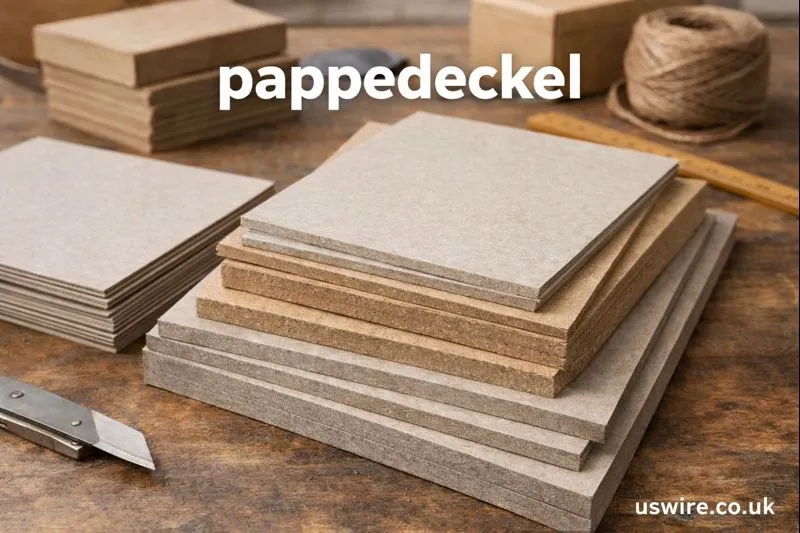
Pappedeckel is a material that often goes unnoticed, yet it plays an important role in many everyday products. From packaging and bookbinding to industrial protection and creative projects, this strong form of cardboard offers reliability, flexibility, and sustainability. Unlike lightweight paperboard, pappedeckel is designed to hold its shape, protect contents, and withstand repeated handling.
As demand grows for recyclable and cost-effective materials, pappedeckel continues to gain relevance. Its simple composition, combined with its wide range of applications, makes it a preferred choice for businesses and individuals alike.
What pappedeckel actually is
Pappedeckel refers to a thick, rigid type of cardboard made by compressing multiple layers of paper fibers. The result is a dense sheet with high stability compared to standard cardboard. It is commonly produced from recycled paper, which adds to its environmental value.
Depending on how it is manufactured, pappedeckel can have a smooth or rough surface and can vary significantly in thickness. These variations allow it to be adapted to different uses, from lightweight backing boards to heavy-duty packaging components.
How pappedeckel is manufactured
The production process begins with paper fibers, often sourced from recycled materials. These fibers are layered, pressed, and dried under controlled conditions. Pressure plays a key role, as it determines the final density and strength of the pappedeckel.
After pressing, sheets are cut to size or prepared for further processing. Some versions remain untreated, while others are laminated or coated to improve appearance or resistance. This controlled manufacturing process ensures consistent quality and predictable performance.
Physical properties and performance
One of the most valued features of pappedeckel is its rigidity. It does not bend easily, making it ideal for structural support. At the same time, it remains lightweight enough to be handled without specialized equipment.
Pappedeckel also offers good resistance to compression, which is essential in packaging and transport. While it is not waterproof by default, it can be combined with coatings or protective layers when moisture resistance is required.
Use of pappedeckel in packaging
Packaging is one of the most common applications of pappedeckel. It is frequently used for box lids, bases, inserts, and separators. These components help protect products during storage and transport while maintaining a clean and professional appearance.
Luxury packaging often relies on pappedeckel as a base material because it provides a solid feel and supports decorative finishes. At the same time, industrial packaging benefits from its durability and affordability, especially for bulk shipments.
Role in bookbinding and stationery
In bookbinding, pappedeckel is essential. It forms the backbone of hardcover books, notebooks, and folders. Its stability ensures that covers remain flat and protect pages over time.
Stationery products such as binders, presentation folders, and portfolios also depend on pappedeckel for structure. The material can be wrapped with paper, fabric, or other finishes, allowing both functional and aesthetic customization.
Industrial and technical applications
Beyond packaging and publishing, pappedeckel is widely used in industrial settings. It serves as a protective layer between products, a stabilizing insert, or a temporary support during manufacturing and transport.
Because pappedeckel is easy to cut and shape, it can be adapted to custom dimensions without significant cost. This makes it particularly useful in logistics and production environments where flexibility is important.
Creative and DIY uses
Pappedeckel is also popular among artists, designers, and hobbyists. Its firm structure makes it suitable for model building, crafts, and display boards. Unlike thinner cardboard, it holds glued elements securely and resists warping.
For creative projects, pappedeckel provides a reliable base that can be painted, covered, or layered. Its accessibility and low cost make it a favorite material for both beginners and experienced creators.
Environmental benefits of pappedeckel
Sustainability is one of the strongest arguments for using pappedeckel. Since it is primarily made from paper fibers, it is recyclable and biodegradable. Many manufacturers rely heavily on recycled inputs, reducing the need for virgin raw materials.
As companies look to replace plastic components with eco-friendly alternatives, pappedeckel offers a practical solution. It supports environmental goals without sacrificing performance or versatility.
Choosing the right type of pappedeckel
Selecting the appropriate pappedeckel depends on its intended use. Thinner sheets work well for backing and light support, while thicker boards are better suited for packaging and structural applications.
Surface quality is another factor to consider. A smoother surface is ideal for visible or decorative purposes, while a rougher finish may be sufficient for hidden or protective uses. Understanding these differences helps ensure the best results.
Long-term relevance in modern production
Despite advances in synthetic materials, pappedeckel remains relevant because of its balance between strength, cost, and sustainability. It fits well into modern production systems that prioritize efficiency and environmental responsibility.
As recycling technologies improve and demand for sustainable materials increases, pappedeckel is likely to remain a key component in many industries for years to come.
Frequently asked questions
What makes pappedeckel different from standard cardboard?
Pappedeckel is thicker and more rigid, offering greater strength and durability.
Is pappedeckel environmentally friendly?
Yes, it is usually made from recycled paper and can be recycled again after use.
Can pappedeckel be customized in size and shape?
It can be easily cut and shaped to meet specific requirements.
Is pappedeckel suitable for heavy packaging?
Thicker versions are well suited for heavy or fragile products.
Can pappedeckel be used for creative projects?
Its stability and ease of handling make it ideal for crafts and design work.
Conclusion
Pappedeckel is a simple yet highly effective material with a wide range of applications. Its strength, adaptability, and environmental advantages make it valuable in packaging, publishing, industry, and creative fields. By offering durability without complexity, pappedeckel continues to meet modern needs while supporting sustainable practices.